
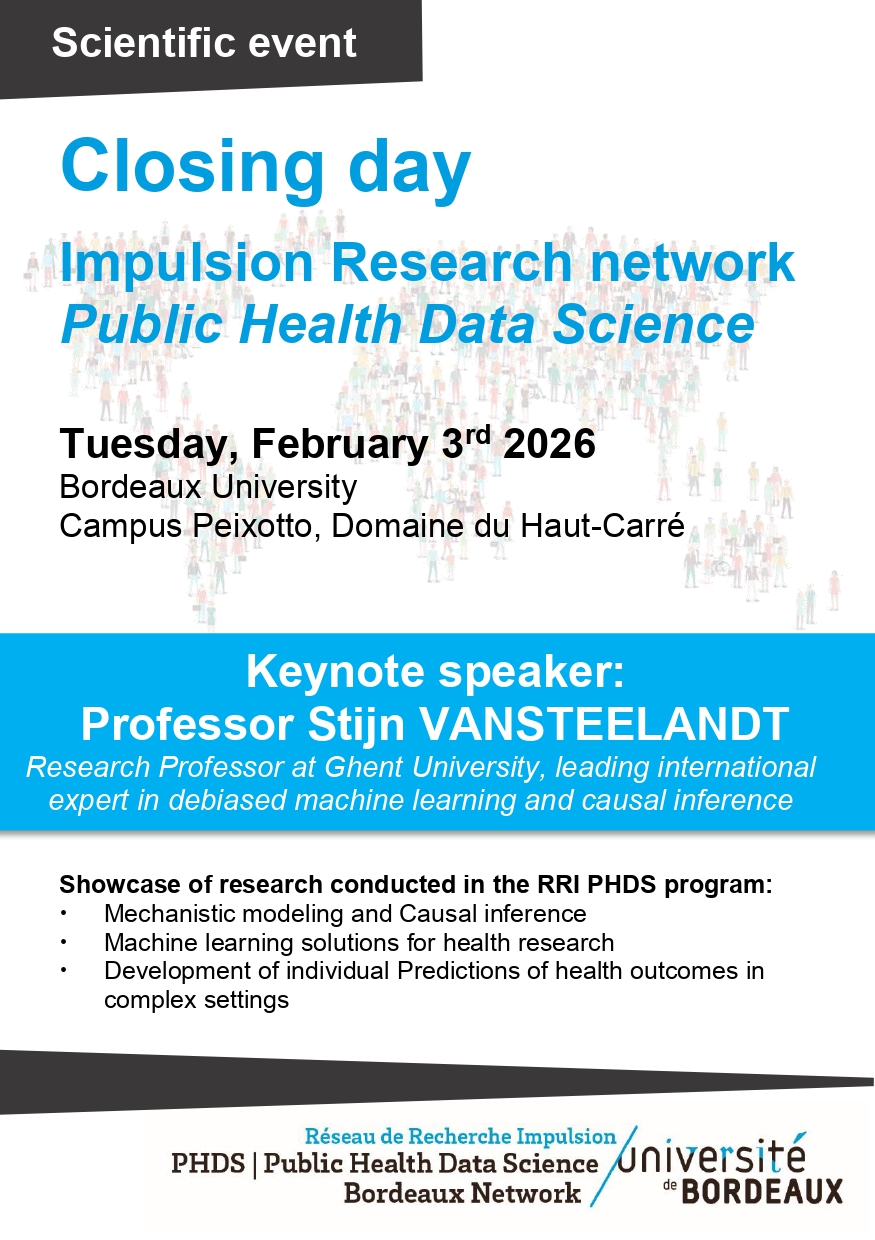
La Journée de clôture du Réseau de Recherche Impulsion « Public Health Data Science » (RRI PHDS) se tiendra le mardi 3 février 2026 de 9h00 à 17h30 dans l’amphithéâtre du Domaine du Haut-Carré à Talence.
Au programme, nous aurons une conférence invitée du professeur Stijn Vansteelandt de l'Université de Ghent, spécialiste d'inférence causale et apprentissage automatique sans biais. La journée se poursuivra par des présentations de travaux de recherche réalisés dans le cadre du réseau PHDS (voir programme détaillé ci-dessous).
La journée est gratuite mais pour des raisons logistiques, merci de vous inscrire au plus tard le 10 janvier 2026 : lien pour vous inscrire
Il sera également possible de présenter un poster, pour plus de renseignements, veuillez écrire à julia.goncalves@u-bordeaux.fr avant le 10/01/2026.
Programme
----------------------------
9h00 - Café de bienvenue
9h30 Introduction
- Antoine PARIENTE, Public Health Department director Rodolphe THIEBAUT, BPH director and Public Health Graduate program director Cécile PROUST-LIMA, RRI PHDS coordinator, Biostat team, BPH
9h50 Keynote speaker
- Stijn VANSTEELANDT - Research Professor at Ghent University - Leading international expert in debiased machine learning and causal inference
10h50 - Pause
----------------------------
11h20 Session “Machine learning solutions in health research”
- Virginie RONDEAU : · Predict breast cancer risk from repeated imaging data using deep neural networks
- Xavier HINAUT : · Introduction to Reservoir Computing towards challenges in health data processing
- Thomas FERTÉ : Epidemic forecasting: lessons learned from the SARS-CoV-2 pandemic to balance accuracy, feasibility, and impact
- Kalidou BA : Deconvolution of bulk RNA-seq data to estimate cell population proportions in presence of missing cellular signatures
- Antonin COLAJANNI : On the methodological difficulties of analyzing the association between microbiome data and a continuous outcome
13h00 - Déjeuner
----------------------------
14h10 Session “Mechanistic modeling and Causal inference”
- Mélanie PRAGUE : Integrating large- to high-dimension markers in mechanistic models
- Ima BERNADA : Network models to decipher the human exposome: application to food exposome patterns in a case-control study on cognitive decline
- Arthur HUGUES : RISE: two-stage rank-based identification of high-dimensional surrogate markers applied to vaccinology
- Aurore LI :Variational autoencoder for inference of nonlinear mixed effect models based on ordinary differential equations
15h30 - Pause
----------------------------
16h00 Session “Development of individual Predictions in complex settings”
- Sébastien RICHARD : Multi-instance learning with missing modalities for multi-modal retinal image grading
- Hélène JACQMIN-GADDA : A two-stage approach for joint modeling of multiple longitudinal markers and competing risk outcomes
- Ariane BERCU : Regularized multi-state modeling for covariate selection with interval-censored survival data
- Corentin SEGALAS : Dynamic prediction of survival outcomes from longitudinal predictors: the functional dynamic random forests
17h20 A visual recap of the day with Donatelle Liens, graphic facilitator
17h45 - Clôture
----------------------------
Programme détaillé
Dernière mise à jour :