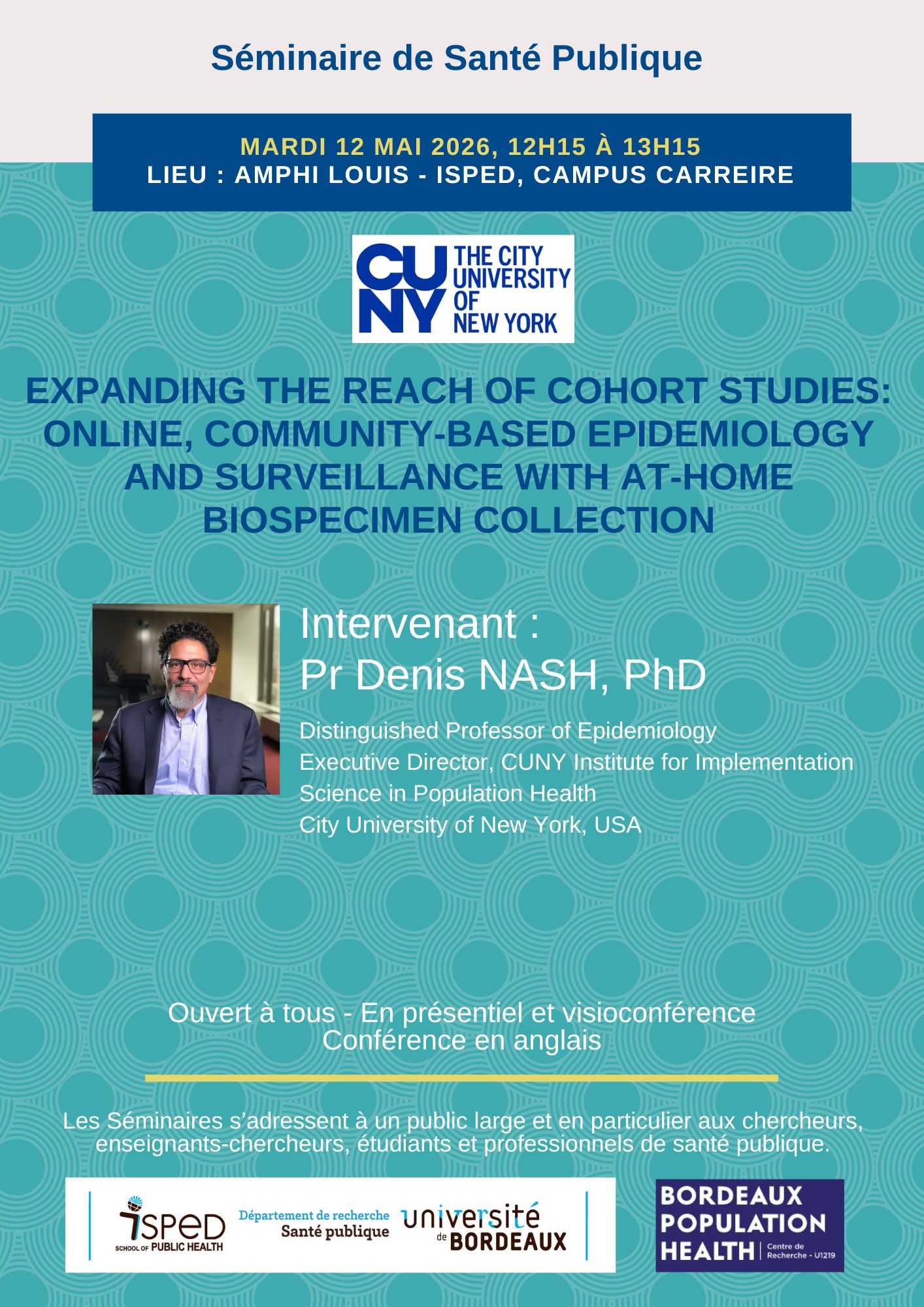
Séminaire de Santé publique
Mardi 12 mai 2026 - 12h15 à 13h15
Amphi Louis - ISPED
Campus Carreire - université de Bordeaux
Ouvert à tous
En présentiel et visioconférence
Seminar in English
Title: Expanding the Reach of Cohort Studies: Online, Community-Based Epidemiology and Surveillance with At-Home Biospecimen Collection
Pr Denis Nash, PhD
Distinguished Professor of Epidemiology
Executive Director, CUNY Institute for Implementation Science in Population Health
City University of New York, USA
https://cunyisph.org/team/denis-nash/
Bio:
Dr. Nash is an epidemiologist with over 20 years of experience and leadership in conducting epidemiologic studies. His central interests include infectious diseases, the field of public health surveillance, the use of public health surveillance data to conduct rigorous assessments of programmatic effectiveness, and the impact of policies on health. He has worked extensively in domestic and international settings conducting large-scale, ‘real-world’ epidemiologic studies examining key outcomes among persons with HIV infection.
Abstract :
This talk will present examples of U.S.-based online cohort studies, including those that use community-based recruitment and at-home, self-collection of biospecimens to address key population health questions. Drawing on the Together 5000 study (HIV prevention), the CHASING COVID Cohort study (COVID-19 and other pandemic-related health outcomes), and Project PROTECTS (SARS-CoV-2, influenza A/B, and RSV), the talk will describe the scientific rationale, study design, recruitment strategies, and operational considerations underlying these efforts. It will also highlight selected findings, discuss the strengths and limitations of online cohort approaches (including how these approaches can complement traditional clinic-based cohorts), consider forward-looking applications (extreme weather events), and consider implications for public health surveillance, epidemic preparedness, and the future of large-scale cohort research.